



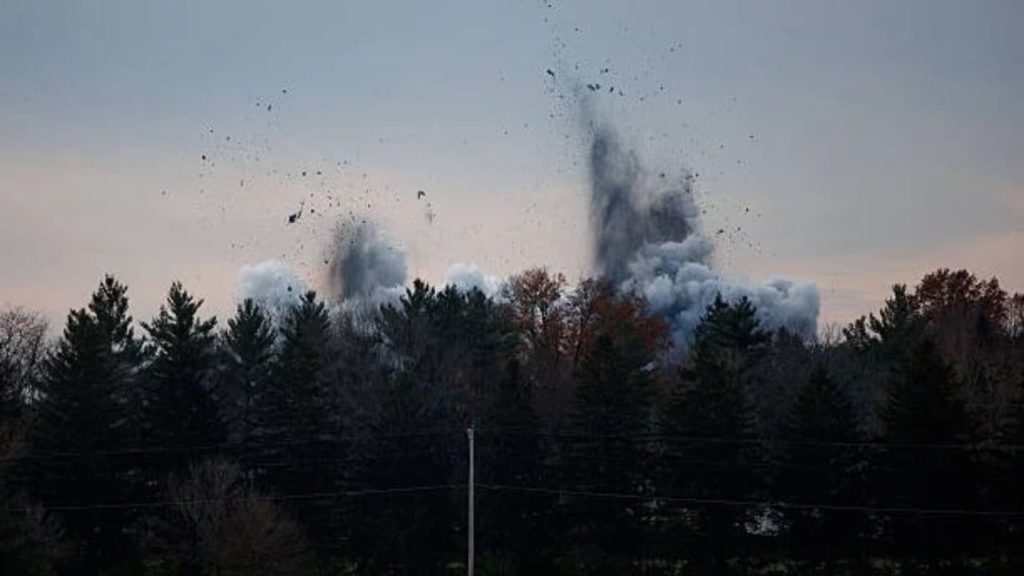
The US Army has completed a controlled detonation of nearly five tonnes of deteriorating lead azide at an ammunition plant in Iowa, but questions remain about the operation’s environmental impact as authorities continue testing surrounding homes, farms and public spaces.
The explosions took place on Wednesday, 25 November, at the Iowa Army Ammunition Plant near Middletown, following days of public concern and legal challenges over how the unstable explosive material should be disposed of.
Residents were evacuated or advised to remain indoors while officials assessed the potential spread of lead particles, according to CNN.
Although authorities later lifted the evacuation and shelter-in-place measures, the return to normal activities does not mark the end of the environmental investigation.
The Environmental Protection Agency (EPA) said its real-time monitoring systems had detected no airborne lead in the region following the detonation. Residents were given the all-clear at approximately 18:30 local time on Wednesday, around nine hours after the explosions.
EPA has amassed an expansive, dedicated team on the ground in Iowa to ensure we are taking every measure possible to protect human health and the environment for local communities. This includes robust sampling/monitoring of air, land, and water, which is taking place before, during, and after the Army’s controlled detonation, scheduled for tomorrow.
— U.S. EPA (@EPA) November 24, 2026
However, the agency has stressed that further testing is necessary. Its latest update, issued on Thursday, 26 November, confirmed that 1 591 samples of air, water, soil and dust had been collected before the detonation, with more than 1 000 additional samples gathered afterwards.
All EPA air monitors continue to report a ZERO DETECT of airborne lead, which has remained consistent before, during, and after this morning’s controlled detonation at the Iowa Army Ammunition Plant. 300 EPA personnel are now sampling air, land, and water across the region. We collected over 1,200 samples before the detonation and are very diligently working to immediately send the new post-event samples back to EPA labs.
We will continue keeping the public updated on the latest information we receive as lab results come in.
You can stay informed by visiting https://t.co/zi6DsTENQw or calling 833-649-9624. Please only use the EPA hotline number if you are in the local area.
— U.S. EPA (@EPA) November 25, 2026
The samples are being sent to laboratories, with the first post-detonation results expected as early as Friday, 27 November. The EPA is also testing for other substances, including volatile organic compounds and particulate matter, that could potentially have been released during the operation.
The Associated Press has reported that post-detonation samples include material collected from homes, parks and drinking water sources. The agency said monitoring would continue for as long as necessary.
Why the Army proceeded with the detonation

The material had been stored at the military installation in 68 deteriorating drums. During inspections, officials identified severe degradation and crystallisation, which increased the risk of an accidental explosion.
The Army considered a controlled detonation the safest available option, according to Reuters, arguing that the increasingly unstable material could otherwise explode without warning as temperatures dropped.
The operation followed disagreement over the disposal plan, including legal action brought by environmental groups seeking to prevent the detonation. The challenge briefly delayed proceedings but did not ultimately stop the Army from proceeding.
Residents had raised concerns about possible lead dust settling on properties, farmland, crops and livestock. Based on the anticipated direction of the plume, approximately 350 farms were identified as potentially affected.
Lead exposure is a particular concern because the metal can cause lasting health effects, especially among children and pregnant people, as Dr Dan McCabe, medical director of the Iowa Poison Control Center, told CNN that there is no safe amount of lead in the human body.
‘So even small amounts in children or patients or pregnant individuals can cause long-term health effects, and they can be mild long-term health effects or severe,’ he stated.
While the initial air-monitoring results have not detected airborne lead, researchers and health specialists have cautioned that these readings cannot establish whether particles settled on surfaces or entered soil and water.
University of Iowa engineering professor David Cwiertny is among those independently monitoring the area. He and his colleagues are collecting soil and dust samples for analysis, with plans to have the findings checked by an independent certified laboratory.
Farmers have also been advised to work with veterinarians to monitor livestock. Guidance from the Iowa Department of Agriculture and Land Stewardship recommends cleaning farm buildings, fencing, feeders, water tanks and equipment after dust particles have settled.
The detonation has also prompted questions about how the ageing explosive stockpile reached such a hazardous condition and whether similar risks could be prevented in future.
Iowa governor-elect Rob Sand called for greater transparency, saying: ‘The lead-up to the detonation should never have been so chaotic and unclear,’ adding that residents deserved to understand how the situation developed.
Meanwhile, Lindsay James, recently elected to represent Iowa’s 2nd Congressional District, also called for accountability.
‘I need answers, we all need answers, Iowans deserve answers,’ she said. ‘How did we get here in the first place? And how are we going to make sure this will never happen again?’
Health and Human Services Secretary Robert F. Kennedy Jr. said federal officials would continue working with Iowa authorities to assess potential health risks and communicate the findings to affected residents.
Be the first to know – Join our WhatsApp Channel for content worth tapping into! Click here to join!
Worth a read:
FAA grounds all US flights after nationwide communications failure
Picture: Getty Images